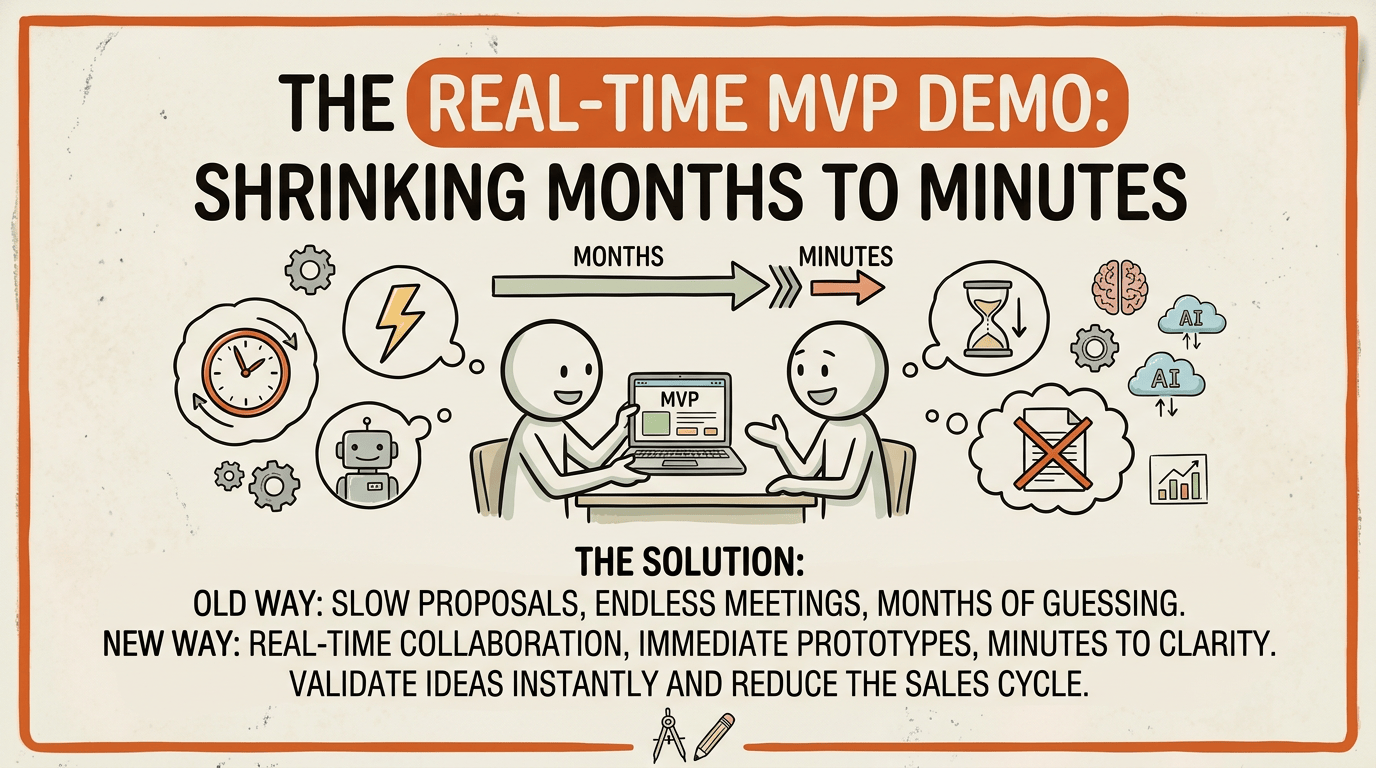
The traditional business development cycle has always followed a predictable rhythm. Discovery, proposal, build. You spend weeks understanding the problem, more weeks writing up what you'd do about it, then months actually building the thing. By the time the client sees something tangible, everyone's forgotten the energy that started the conversation.
That cycle is collapsing.
The Signal
AI tools like Claude Code, Codex, and Antigravity now make it possible to build working prototypes live in the room or on the call, during the conversation. Not mockups. Not wireframes. Functional demos that respond to real inputs and solve the actual problem being discussed in front of the customer's eyes.
So what does this translate to? Well, firstly, the time between "here's my problem" and "here's a working solution" has shrunk from months to minutes. What used to require a proposal document, a statement of work, and a project kickoff can now start with someone opening a laptop and saying "let me show you what I mean."
Secondly, it expands the opportunities for surprise and delight. When you can build something live, you create moments that a PDF or a pitch deck simply can't. The customer sees their problem being understood and solved simultaneously. They get to shape the solution as it takes form, pointing out things you'd never have caught in a requirements document. That collaborative energy is completely different to reviewing a proposal in your inbox three weeks later.
This isn't a small efficiency gain. It's a fundamental shift in how value gets demonstrated and the relationship between the customer and the business.
The Take
I've seen this play out in real time. Instead of spending a week preparing a polished deck explaining what an AI workflow could do for a business, I can build a rough version of it while we're talking. The client sees their own data flowing through a real system, not a conceptual diagram on slide twelve.
Take Yi Collection, a global fine jewellery brand. I sat down with Yi, the founder, to understand how her business actually operates day-to-day. Within the first few minutes she's showing me the problem on her screen.
Her team creates proposals for wholesale partners by manually screenshotting each product from Shopify, pasting it into an Excel spreadsheet alongside the style number, weight, price, and sizing. One by one. Because Shopify's export won't include the product photos, and buyers need to see what they're selecting - jewellery is visual, you can't just read "chain ring tanzanite emerald" and know what you're looking at.
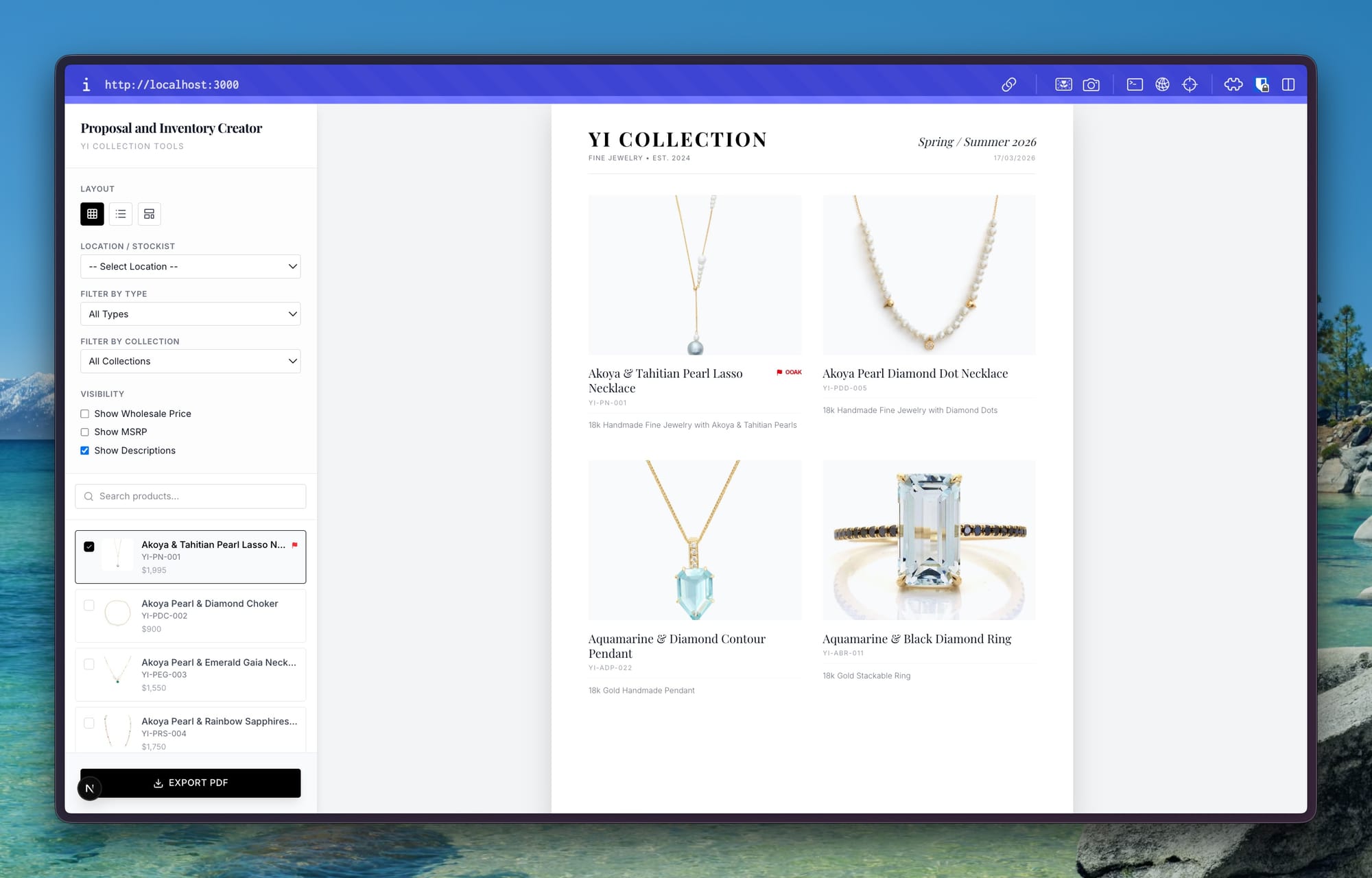
They do this at minimum three times a year across twelve stores. Each proposal takes almost an entire day per person. That's 36 days a year spent copy-pasting screenshots into spreadsheets. And the proposal doesn't end there - once a buyer selects which pieces they want, that same spreadsheet becomes the inventory tracker for that store. When a store sells something, they email Yi's team, and someone manually updates both the spreadsheet and Shopify. For every store. Every month.
With the app I built, that same proposal takes minutes. Select the products from a grid, click a button, done. The photos, prices, and SKUs pull straight from Shopify automatically - no screenshotting, no copy-pasting. Thirty-six days of manual work a year, reduced to a few hours total. And the inventory tracking that used to mean chasing emails and manually updating two systems? The app handles that too.
So while she's explaining this, I opened my laptop and started building with Claude Code and Antigravity. Not a proposal. Not a scope document. The actual thing. A web app that pulls directly from her Shopify catalogue - photos, prices, SKUs, the lot - and lets her team generate proposals by selecting products and clicking a button. Right there, in the conversation.
Her response wasn't "send me a proposal and we'll review it." It was "send me the link, I want to try it."
That's the difference. A proposal creates distance - it's a document that sits between you and a decision. A working demo collapses that distance entirely. People aren't evaluating an idea anymore. They're reacting to something they can touch, and that changes the conversation completely.
Where We're Heading
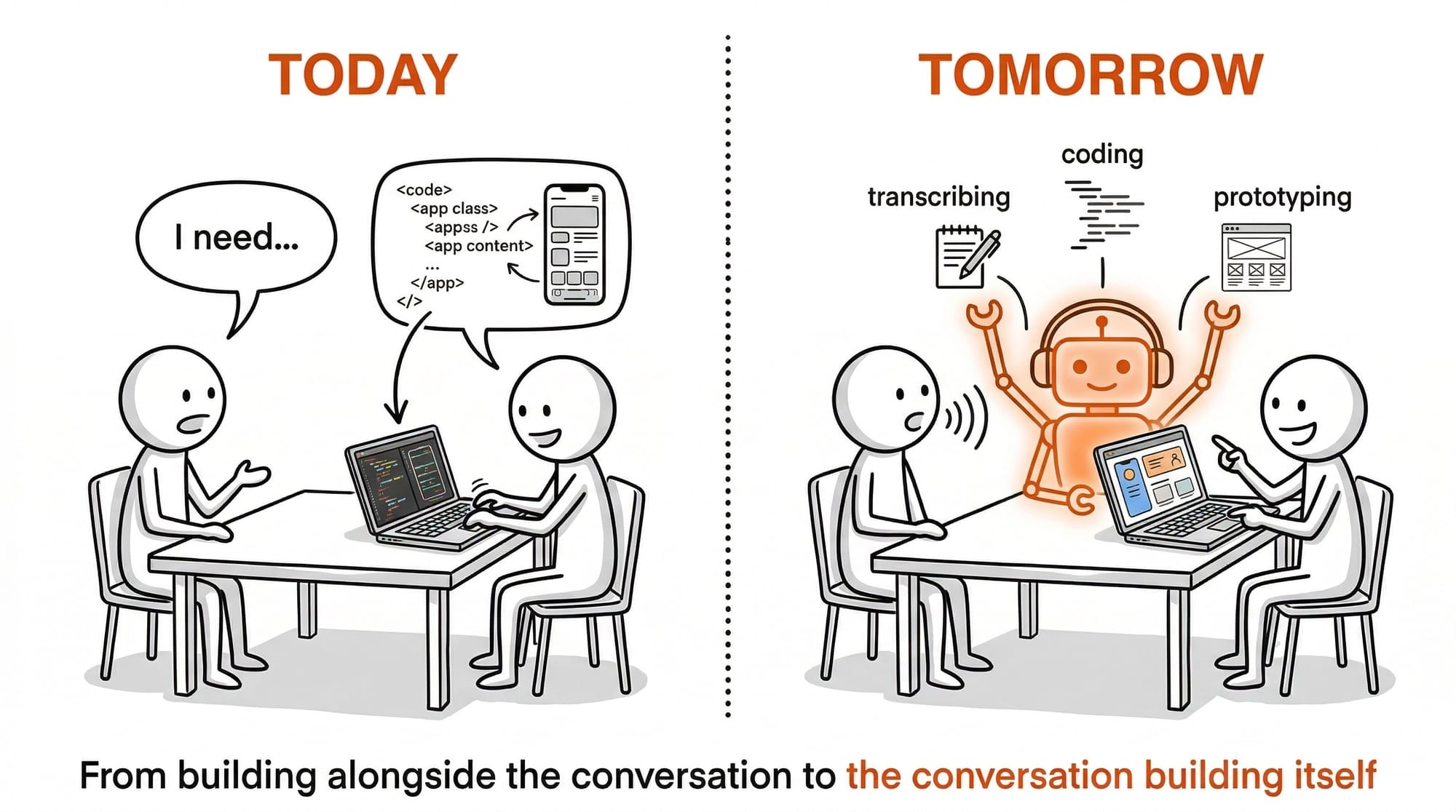
This is going further. Picture a AI agent (I like to call them Remote Humans) - a specialised digital teammate that's listening to the conversation in real time - transcribing what's being said, understanding the requirements as they're discussed, and prototyping solutions as the dialogue unfolds. It knows your business, your workflows, your style and more to create working solutions that represent your brand and your business. You guide the conversation, the agent builds alongside it. We're close to this. AI can already transcribe and process multi-lingual audio in real time. Coding agents are becoming faster and more capable with every release. The LLMs (Large Language Models, or just think of them as the brains that can think and reason) powering them are getting quicker. Put those things together and you get something that can listen, process, and create in near real time with little technical knowledge.
That means the surface area for what can happen in a single conversation expands dramatically. Instead of leaving a meeting with action items and a timeline, you leave with working software. The entire creation process shifts from "we'll get back to you" to "let's figure this out together, right now."
New Roles Emerging
This pattern is showing up everywhere, and it's creating roles that didn't exist a few years ago.
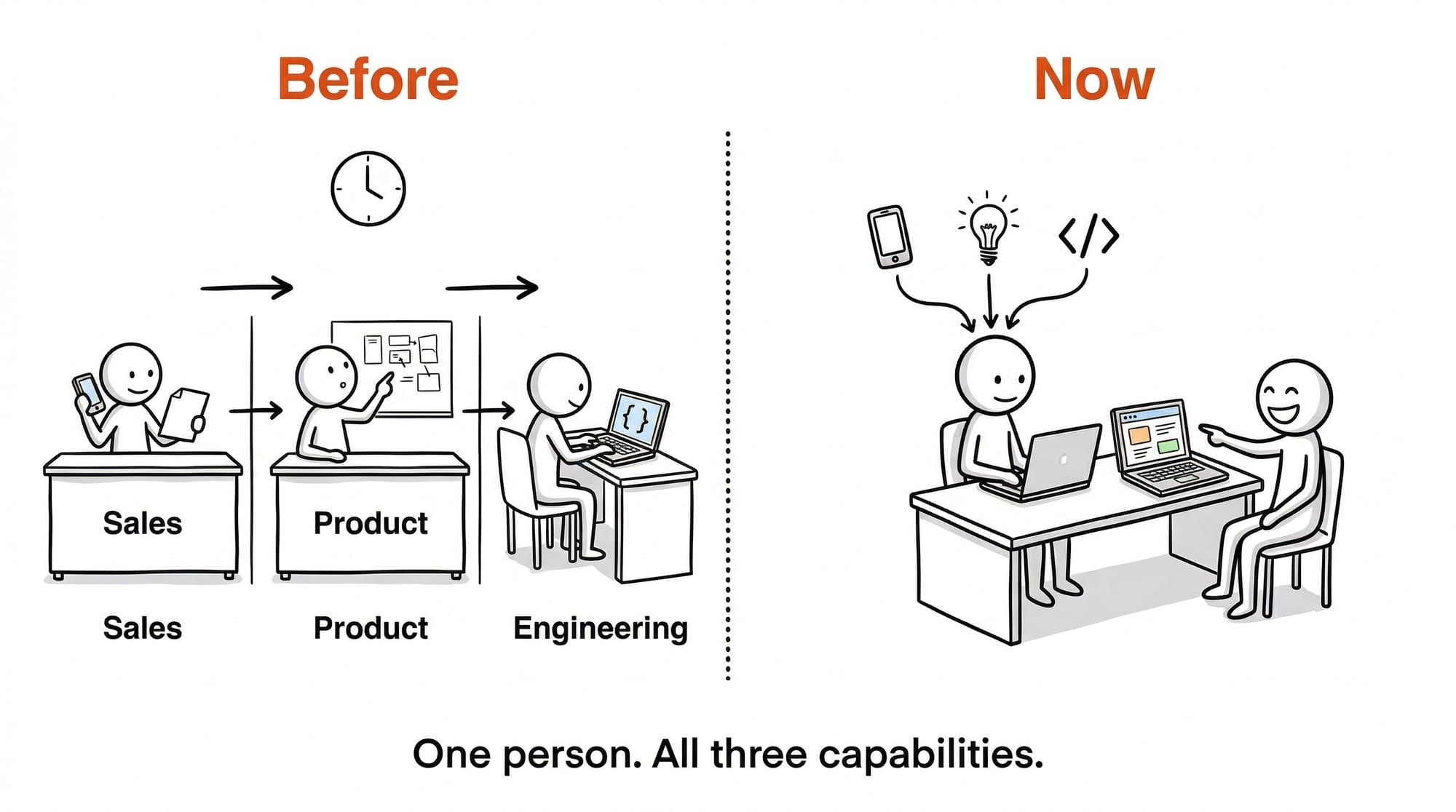
Anthropic is hiring Forward Deployed Engineers - people who embed directly with customers and build production applications on-site using Claude. The job description talks about creating "MCP servers, sub-agents, and agent skills for enterprise workflows." These are people who sit with the customer, understand the problem, and ship the solution - all in the same engagement. And to me, that sounds a lot like a business analyst, product manager, a developer and perhaps even a solutions architect all wrapped up in one.
What I did with Yi is the same instinct at a different scale. And I'm seeing this pattern repeat across consulting, agencies, and technical sales. The person in the room increasingly needs to be the person who can build the thing. Sales, product, and engineering are merging into a single capability, and the people who can operate across all three are going to be in serious demand.
The businesses that grasp this will move faster and have better customer satisfaction. Not because they've hired more people, but because they've removed the lag between identifying a problem and proving it can be solved, and expanded the possibility for surprise and delight along the way.
Less grind. More growth. More joy.
Things to Think About
- You don't need to be technical to create solutions anymore. AI tools let non-technical people build things that previously required a whole team of developers, designers, and product managers.
- The time it takes to go from idea - or shitty first draft to working solution has shrunk dramatically. What took months now takes minutes. That speed changes how your business can respond to problems and opportunities.
- Roles are merging. The person who understands the customer's problem is increasingly the same person who can solve it on the spot. Sales, product, and engineering are becoming one skillset.
- When you bring AI into your team's workflows, things that weren't possible before become possible. It's not just about doing the same work faster - it's about doing work that was never done at all.
- AI expands the surface of surprise and delight for your customers. It feels magical watching ideas come to life in front of their eyes
- New ways of working need to be explored. The old playbook of proposals, timelines, and handoffs is being replaced by something more immediate and collaborative. This is one way to start exploring what that looks like.
- Think about the repetitive work in your business - the stuff that eats time but doesn't require creativity. That's where to start. Describe the problem in plain English to an AI tool and see what it comes back with. You don't need to be technical.
- Tools like Claude Cowork, Claude Code, and OpenClaw are specifically designed to let non-technical people create technical solutions. These are the AI agents making this shift possible - worth exploring if any of this resonates.
Glossary
- LLM (Large Language Model) - an AI brain that can reason, understand, and create things like code, text, images, and audio. Think of it as the engine behind tools like ChatGPT and Claude.
- Claude Code / Codex / Antigravity - tools that let you describe what you want in plain English and they build it for you. Like telling an assistant "make me a dashboard that does X" and watching it appear.
- MCP (Model Context Protocol) - a way to plug AI into the tools you already use, like your email, calendar, or Shopify store, so it can actually do things rather than just talk about them.
- Forward Deployed Engineer - someone who shows up at your business, learns how you work, and builds solutions on the spot rather than going away and coming back weeks later.
- API (Application Programming Interface) - the behind-the-scenes plumbing that lets different apps share information. It's how your online store talks to your accounting software, for example.
- Prototype - a rough working version of something, built quickly to test whether the idea works before investing serious time and money.
PS - If you're interested in learning how to build workflows and systems with AI in your business, I run Leader Lab - 1-1 or group coaching where we work through your specific challenges together. No generic course material. Your problems, your tools, your pace.