I've been deep in AI implementation work for a while now - helping business owners and leaders figure out what's actually useful versus what's noise. And I keep noticing things. A shift.
Patterns. Shifts in how work gets done that are rather substantial but easy to miss if you're not looking.
A go-to-market team pushing code changes to their own product. An engineer who hasn't opened a code editor in a month because the AI writes every line. A founder restructuring their entire company - not because things are bad, but because smaller teams with AI tools are outperforming the old model.
These aren't hypothetical scenarios. They're happening now, in real businesses, and the pace is accelerating.
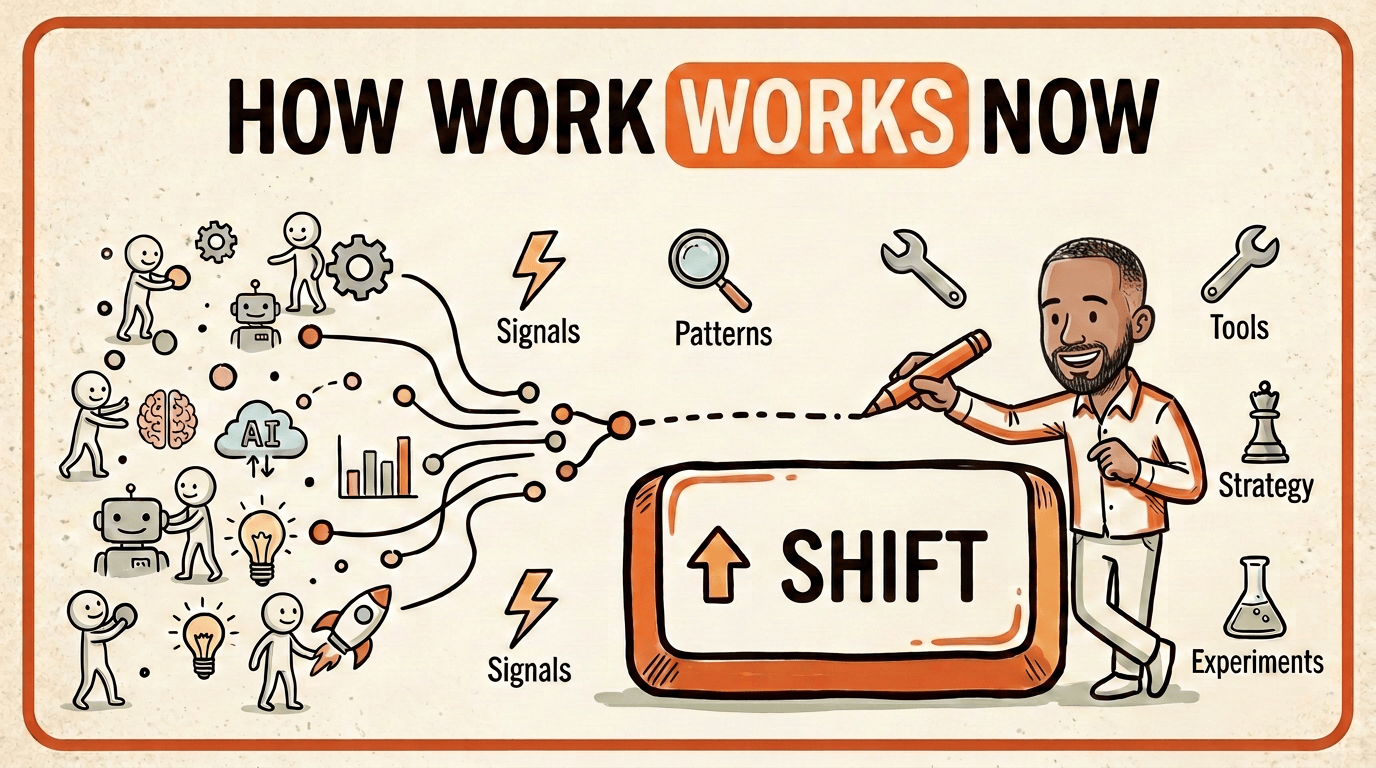
How Work Works Now is where I'll be tracking all of it.
What this is
Think of it as a running log of what I'm seeing, what I'm trying, and what I think it means for how you run your business.
Some of these are subtle smaller signals, others are much larger shifts. And when you combine them all together, they form patterns and transitions all heading in a general direction.
Some posts will be quick - a quote from someone doing interesting work, a link to something worth reading, and my take on why it matters. I'm calling these Signals.
Other posts will go deeper. When I spot a pattern that keeps showing up across different businesses and industries, I'll pull it apart - what's actually happening, why it works, and how you might apply it. My aim is to help you connect the dots between how AI's being used in seemingly non-obvious ways, which when you both zoom out and zoom back in and let them marinate over the coming weeks, months and years, you'll see new ways of working suddenly become apparent.
These will cover:
- Patterns - The recurring ways people are working with AI that actually deliver results
- Tools - Practical field reports on specific AI tools. Not reviews. More like "here's what happened when I actually used this"
- Strategy - The bigger picture stuff. How businesses are restructuring, how roles are changing, what leaders should be paying attention to
- Experiments - Write-ups when I try something new. What worked, what didn't, what I'd do differently
Why this matters right now
Most businesses know AI is important. Far fewer know what to actually do with it. There's a gap between "we should be using AI" and "here's specifically how we're using it to get work done" - and that gap is where most people are stuck.
Meanwhile, the businesses that are figuring it out are moving fast. Teams are restructuring. Roles are expanding. Entire workflows that took weeks are happening in hours. And these aren't just the sexy tech companies - it's law firms, consultancies, creative agencies, operations teams. It's funeral directors streamlining family communications and aftercare. Games studios where a single developer is building what used to need a team of ten. HVAC companies automating scheduling and quoting. Architects generating planning documents in minutes. Recruitment agencies screening and shortlisting candidates while they sleep.
And often, what didn't work last month suddenly just...works.
The "boring" businesses - the ones people don't associate with AI - are often the ones with the most to gain. Often lacking even basic automations, and mostly relying on manual processes and tacit knowledge kept in people's minds.
How work works now is already substantially different from how it worked a year ago. We know how stuff gets done in five or ten years will be unrecognisable, however, few know what that looks and feels like in real practical terms today. That said, it's clear to me the building blocks for that future are being put in place right now, by the people and businesses willing to experiment and adapt.
This blog is about showing you what those people are doing - across industries you'd expect and ones you wouldn't - so you can see the opportunities and figure out what makes sense for your business.
Who I am

I'm Elliott Callender. I sit between tech and humans - always have.
For 18 years, I've made complex technology disappear - working with Fortune 500s and FTSE 100s through to growing SMBs, transforming distributed teams from chaos to systems, and designing learning experiences that actually stick. I've reinvented myself multiple times, and figured out how to find joy each time.
Now I run Remote Humans. I help business owners and leaders become AI fluent - through hands-on 1-1 coaching, group sessions, and building bespoke AI systems and workflows. Whether you want to learn to build it yourself or have us build it for you, the outcome is the same: less manual work, more done with less, and hours back in your week.
This blog is where I share what I'm seeing across all of that work - the patterns, the tools, and the shifts that are changing how businesses actually operate.
If that sounds useful, subscribe and I'll send new posts to your inbox.
Less grind. More growth. More joy.